
Teeth whitening can be a great way to refresh your smile and help you feel more confident. Unfortunately, traditional approaches to teeth whitening won’t work if one tooth has turned gray, yellow, or brown after an injury or root canal on a front tooth. Internal bleaching is often the most conservative way to fix this issue. Our own Dr. Nestle performs internal tooth bleaching in Orlando, FL to give your smile a harmonious, uniform appearance again!
This post explains how internal bleaching works, how it can whiten a dead tooth, and how this approach compares to other options like veneers and crowns.
Why Won’t My Tooth Get Lighter with Teeth Whitening?
When a tooth loses its blood supply, such as after an injury, extensive damage, or root canal treatment, the soft tissue inside the tooth breaks down. This releases dark pigments deep inside the tooth structure.
This process may not happen right away. In fact, a tooth may not “die” or become discolored for months or even years after it loses its blood supply.
Unfortunately, most methods for teeth whitening work from the inside out, so dead and root canal treated teeth don’t respond to it. That’s where internal bleaching comes in.
What Is Internal Tooth Bleaching?
Internal bleaching lightens a tooth from the inside out. Rather than applying gel or strips to the outer surface of the tooth, it involves placing the whitening agent inside the tooth itself and sealing it for a short period.
The most common approach to internal bleaching is also called “walking bleach” because you wear the whitening treatment as you walk around for the next several days. This allows the whitening agent to work on the discolored dentin until it reaches the target shade.
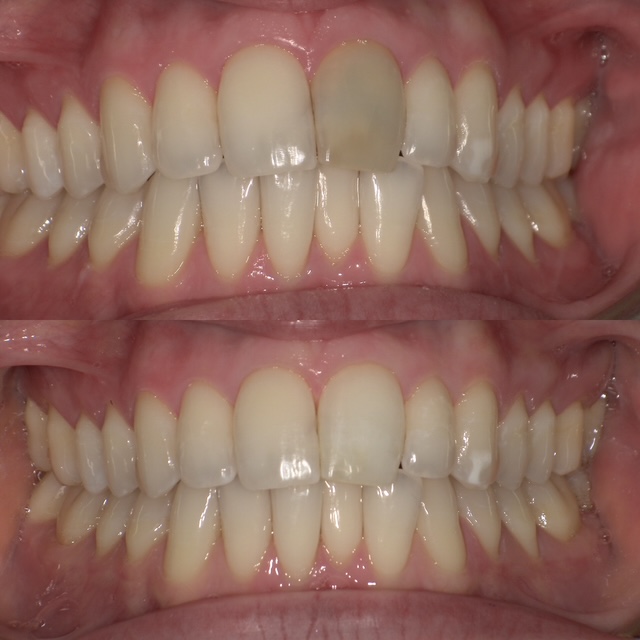
Why Does a Tooth Darken?
A tooth can change color from the inside for several reasons. The most common are:
- Trauma. A blow to the tooth can cause bleeding inside the pulp. As the blood breaks down, it may turn dark. This can happen years after the injury.
- Root canal treatment. Remnants of pulp tissue, blood products, or certain filling materials can make a tooth look gray or yellow over time.
- Internal changes in the tooth. In some cases, a tooth may lose its blood supply without an injury or root canal treatment. For example, aging can cause the pulp chamber to shrink. This may lead to unexpected discoloration of just one tooth.
Does internal bleaching always come after a root canal on a front tooth?
Internal bleaching may be a good option if the discolored tooth has already had a successful root canal, and the surrounding root and gum tissue are healthy. A tooth that has not had a root canal, or one with an active infection, needs to be evaluated first because other treatments may need to come before any whitening.
Darkening and discoloration are very common after a root canal on a front tooth, but it doesn’t always happen. In that case, internal bleaching is not necessary.
What are the alternatives to whiten a dead tooth?
There are other options to whiten a dead tooth, but internal bleaching is frequently a conservative, lower-cost first step before considering other treatments. A veneer can cover the dark tooth and help it blend in with your smile, and a crown is a great option for a tooth that’s had extensive damage or large restorations in the past.
These treatments involve reshaping the natural tooth, so internal bleaching is a great way to preserve as much of your natural tooth structure as possible. In some cases, we may recommend internal bleaching before other cosmetic treatments like veneers to prevent the dark tooth from showing through the restoration and affecting its shade.
Our team will carefully evaluate your specific needs and help you choose the best approach for your smile goals and oral health.
What to Expect During the Procedure
Internal bleaching a tooth is usually done over a few short, comfortable visits. Because the tooth no longer has a nerve, it has no feeling of its own, so the feeling is typically painless. We may provide numbing if you have sensitivity or tender gums in the area.
- Evaluation. We’ll examine the tooth and take an X-ray to confirm that the root canal is sound and there is no infection.
- Preparation. Dr. Nestle will create a small access opening in the back of the tooth (usually working through the same access that was used for your root canal treatment).
- Placing the whitening agent. We’ll place the whitening agent inside the crown of the tooth and seal it with a temporary filling.
- Checking your progress. The whitening will work while you go about your normal routine. After a few days, we’ll check the tooth color and refresh the whitening agent if needed.
- Final restoration. Once we achieve the best possible results, we’ll remove the whitening agent and place a tooth-colored filling to permanently seal the tooth.
In most cases, internal tooth bleaching takes one to three visits, although this varies with how dark the tooth is and how long it has been discolored. If we can’t achieve the final shade you’re hoping for, we’ll discuss additional options like cosmetic bonding or veneers.
Wondering How to Whiten a Dead Tooth? We Can Help!
If you have a tooth that has darkened after an injury or root canal, it is worth having it looked at. While this type of darkening is harmless in most cases, there are more serious issues that can cause discoloration.
Get in touch to schedule a consultation for internal tooth bleaching in Orlando! Our team will examine the tooth, explain why your tooth looks darker, and walk you through your options.